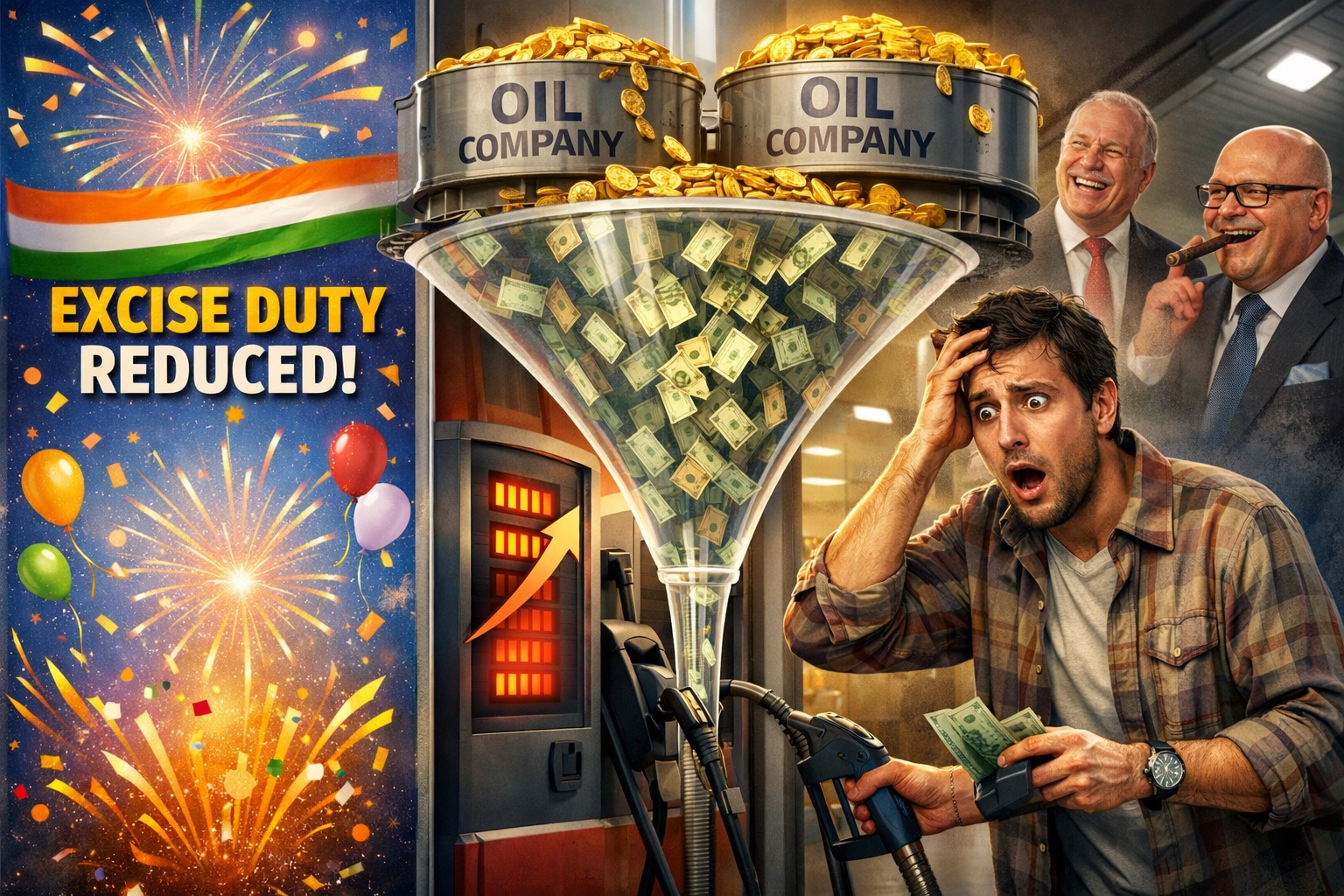
On the evening of March 26, the Finance Ministry issued Notification No. 11/2026-Central Excise, slashing the special additional excise duty on petrol from ₹13 to ₹3 per litre and cutting diesel's excise to zero. The news made every front page. Social media celebrated. "Big relief," the headlines said.
Then morning came. You drove to the pump. The price board read ₹94.77 for petrol. ₹87.67 for diesel. Exactly what it was yesterday. And the day before. And every day since oil prices started surging on February 28.
The ₹10 cut is real. The savings are not — at least not for you.
₹10 Cut. ₹0 Saved. Where Did the Money Go?Here's what happened. Since the Iran war began and the Strait of Hormuz was effectively closed, international crude oil prices have surged nearly 50% — from around $81 to over $106 per barrel. But the government told state-owned oil marketing companies (OMCs) — Indian Oil Corporation (IOCL), Bharat Petroleum (BPCL), and Hindustan Petroleum (HPCL) — to keep pump prices frozen.
The OMCs obeyed. They absorbed the price difference. And they started bleeding money — ₹48.8 per litre on every litre of petrol and diesel sold.
The excise duty cut is a government bailout of these three companies. Not a price cut for consumers.
| What Changed | Petrol | Diesel |
|---|---|---|
| Excise duty (before) | ₹13/litre | ₹10/litre |
| Excise duty (after) | ₹3/litre | ₹0 (zero) |
| Cut amount | ₹10/litre | ₹10/litre |
| Your pump price (before) | ₹94.77 (Delhi) | ₹87.67 (Delhi) |
| Your pump price (after) | ₹94.77 (unchanged) | ₹87.67 (unchanged) |
| Your savings | ₹0 | ₹0 |
Petroleum Minister Hardeep Singh Puri acknowledged the government had "taken a significant hit on tax revenues" to offset heavy losses faced by oil companies — estimated at ₹24 per litre for petrol and ₹30 per litre for diesel.
Madhavi Arora, an economist at Emkay Global, estimated the annualized fiscal hit at ₹1.55 lakh crore (₹1.55 trillion). That's roughly the size of India's entire annual education budget.
But even this massive sacrifice covers only 30-40% of the OMCs' losses. The companies are still underwater. At current oil prices, the remaining 60-70% of the loss — roughly ₹28-34 per litre — sits on the companies' balance sheets.
₹9.48. ₹32.90. ₹3. The Government's Fuel Tax Rollercoaster.To understand why this cut matters politically but not practically, you need to see the full timeline of how excise duty on petrol has moved since 2014.
| Year | Event | Excise on Petrol | What Was Happening |
|---|---|---|---|
| 2014 | BJP comes to power | ₹9.48/L | Global oil prices falling |
| 2014-16 | 9 excise hikes | ₹21.48/L | Oil crashed to $28; govt pocketed the difference |
| 2017-18 | 2 small cuts | ₹19.48/L | Pre-election relief before 2019 |
| Jul 2019 | Hike | ₹21.48/L | Post-election; oil stable |
| Mar-May 2020 | 2 massive hikes during COVID | ₹32.90/L (peak) | Oil crashed to $20; people locked at home |
| Nov 2021 | Cut before state elections | ₹27.90/L | Fuel prices hit all-time highs |
| May 2022 | ₹8 cut | ₹19.90/L | Inflation crisis, RBI raising rates |
| Mar 2026 | ₹10 cut (current) | ₹3/L | Iran war, oil above $100 |
The pattern is clear. When international oil prices crashed (2014-2016, COVID 2020), the government raised excise duty and kept the savings instead of passing them to consumers. The total excise collected from fuel jumped 300% between 2014 and 2020. When prices rose again, the government cut excise — but framed it as "relief" even though it was returning money it had collected when oil was cheap.
While government-owned Indian Oil, BPCL, and HPCL kept prices frozen on orders from the Centre, private fuel retailer Nayara Energy — which operates over 6,900 petrol pumps across India — quietly raised prices: petrol by ₹5 and diesel by ₹3 per litre.
This is significant because it reveals the market reality that the government's frozen prices are masking. Private companies, which aren't obligated to follow government pricing directives, are pricing fuel at what it actually costs. Nayara's petrol now costs ₹100.71 per litre — nearly ₹6 more than Indian Oil's ₹94.77.
The gap between the government's price and the market price is ₹48.8 per litre. Someone is paying for that gap. Right now, it's the oil companies. If this continues, it will eventually be the taxpayer — through dividends the government won't receive and balance sheets that need recapitalization.
The Government's Case
- "We took a significant fiscal hit to protect consumers" — Petroleum Minister Puri
- Without frozen prices, petrol would be ₹140+ per litre in Delhi
- The excise cut prevents OMCs from going bankrupt, which would cause supply disruptions
- Inflation would spike if fuel prices were deregulated during this crisis
What Critics Say
- The ₹10 cut is an oil company bailout, not consumer relief
- The government raised excise by ₹23+ when oil was cheap (2014-2020) — this is just partial return
- Frozen prices create artificial shortages and black marketing (12,000+ raids already)
- The ₹1.55L crore fiscal hole will eventually be funded by the same taxpayers
The annualized revenue loss of ₹1.55 lakh crore is not abstract. It has to come from somewhere. The government has three options:
| Option | What It Means | Who Pays |
|---|---|---|
| Higher fiscal deficit | Government borrows more, pushing up interest rates | Taxpayers (through higher borrowing costs) |
| Cut other spending | Reduce infrastructure, welfare, or defence budgets | Citizens (through reduced services) |
| Raise other taxes | Increase GST, income tax, or import duties | Consumers and businesses |
There is no version of this where the public doesn't eventually pay. The question is only whether the payment is visible (higher fuel prices) or invisible (higher deficits, reduced spending, other tax hikes).
What Happens If Oil Stays Above $100?The excise cut buys time. But it doesn't solve the underlying problem. At $100+ per barrel, India's oil import bill rises by roughly $25-30 billion per year. The OMCs continue losing ₹38+ per litre even after the excise cut. And the government's tax revenue from fuel — once its most reliable cash cow — is now near zero on diesel and minimal on petrol.
If the Iran war continues and Brent crude stays elevated, the government faces a binary choice: either let prices rise (and face the political consequences) or recapitalize the OMCs with taxpayer money (as it did in 2008-2013, spending over ₹1.4 lakh crore in oil bonds that taxpayers are still repaying).
Meanwhile, the government has also raised the export duty on diesel to ₹18.5 per litre — essentially telling refiners to keep fuel domestic rather than sell it abroad for higher prices. This protects supply but squeezes margins further.
What You're Paying Right Now (March 27, 2026)Despite the excise cut, here's what you're paying at the pump today — exactly the same as yesterday:
| City | Petrol (₹/L) | Diesel (₹/L) | Change After Cut |
|---|---|---|---|
| Delhi | ₹94.77 | ₹87.67 | No change |
| Mumbai | ₹103.54 | ₹90.03 | No change |
| Kolkata | ₹105.45 | ₹92.02 | No change |
| Chennai | ₹100.84 | ₹92.39 | No change |
| Bengaluru | ₹102.92 | ₹90.99 | No change |
| Hyderabad | ₹107.46 | ₹95.70 | No change |
Source: Indian Oil Corporation daily price bulletin, March 27, 2026
Your Questions, Answered Q: The government cut excise by ₹10. Why didn't my petrol price drop?Because the cut wasn't meant for you. Oil marketing companies (IOCL, BPCL, HPCL) have been selling fuel at a loss of ₹48.8 per litre since the Iran war spiked crude prices. The government's excise cut reduces the tax these companies owe — giving them ₹10 of breathing room per litre. Your pump price stays the same because it was already being sold below cost.
Q: So who actually benefits from this cut?The direct beneficiaries are three state-owned oil companies: Indian Oil Corporation, Bharat Petroleum, and Hindustan Petroleum. They were losing ₹48.8 per litre. After the excise cut, they lose ₹38.8 per litre. The government gave up ₹1.55 lakh crore in annual tax revenue to keep these companies from going bankrupt.
Q: Will petrol and diesel prices eventually come down?Unlikely in the near term. Prices are frozen by government directive. They've been unchanged since April 2022. For pump prices to actually fall, either international crude prices need to drop significantly (below $70-75/barrel) or the government needs to order OMCs to cut prices — which would deepen their losses further.
Q: Premium petrol prices went up. Why?Yes — premium (branded) petrol was hiked by ₹2/litre. Premium fuels have a different pricing structure with lower government control. Similarly, bulk diesel for industrial users was raised by approximately ₹22/litre. The freeze only applies to regular retail petrol and diesel.
Q: Nayara Energy raised prices. What does that mean?Nayara Energy (which operates 6,900+ pumps) is a private company — not government-owned. It raised petrol by ₹5 and diesel by ₹3 because it can't absorb losses the way government-backed OMCs can. This shows the true market price of fuel is higher than what you see at government pumps. The gap between Nayara's price (₹100.71 petrol) and IOC's (₹94.77) is the subsidy you're receiving — paid by OMC losses.
Q: The government raised excise when oil was cheap (2014-2020). Isn't this just returning what they took?Partially, yes. Excise duty on petrol went from ₹9.48 in 2014 to ₹32.90 in 2020 — the government pocketed the savings from falling global oil prices instead of passing them to consumers. Central tax collection on fuel jumped 300% in six years. The current cut to ₹3 is the lowest excise has ever been — but consumers don't see it because the ₹10 goes to OMCs, not to lower prices.
Q: How does this affect inflation?By keeping pump prices frozen, the government is preventing a direct inflation spike. If fuel prices were deregulated at current crude prices, petrol would cost ₹140+ in Delhi. That would cascade into transport costs, food prices, and everything else. The excise cut is essentially an anti-inflation measure — but funded by a ₹1.55 lakh crore hole in the budget that will eventually need to be filled.
The Bottom Line
The ₹10 excise duty cut is real, but the beneficiary is not you. It's Indian Oil, BPCL, and HPCL — state-owned companies that have been ordered to sell fuel at a ₹48.8 per litre loss. The government is absorbing ₹1.55 lakh crore in lost revenue to keep these companies alive, not to reduce your bill. Your petrol still costs ₹94.77. Your diesel still costs ₹87.67. The only thing that changed is who pays for the gap between what oil costs and what you're charged — and that, one way or another, is still you.