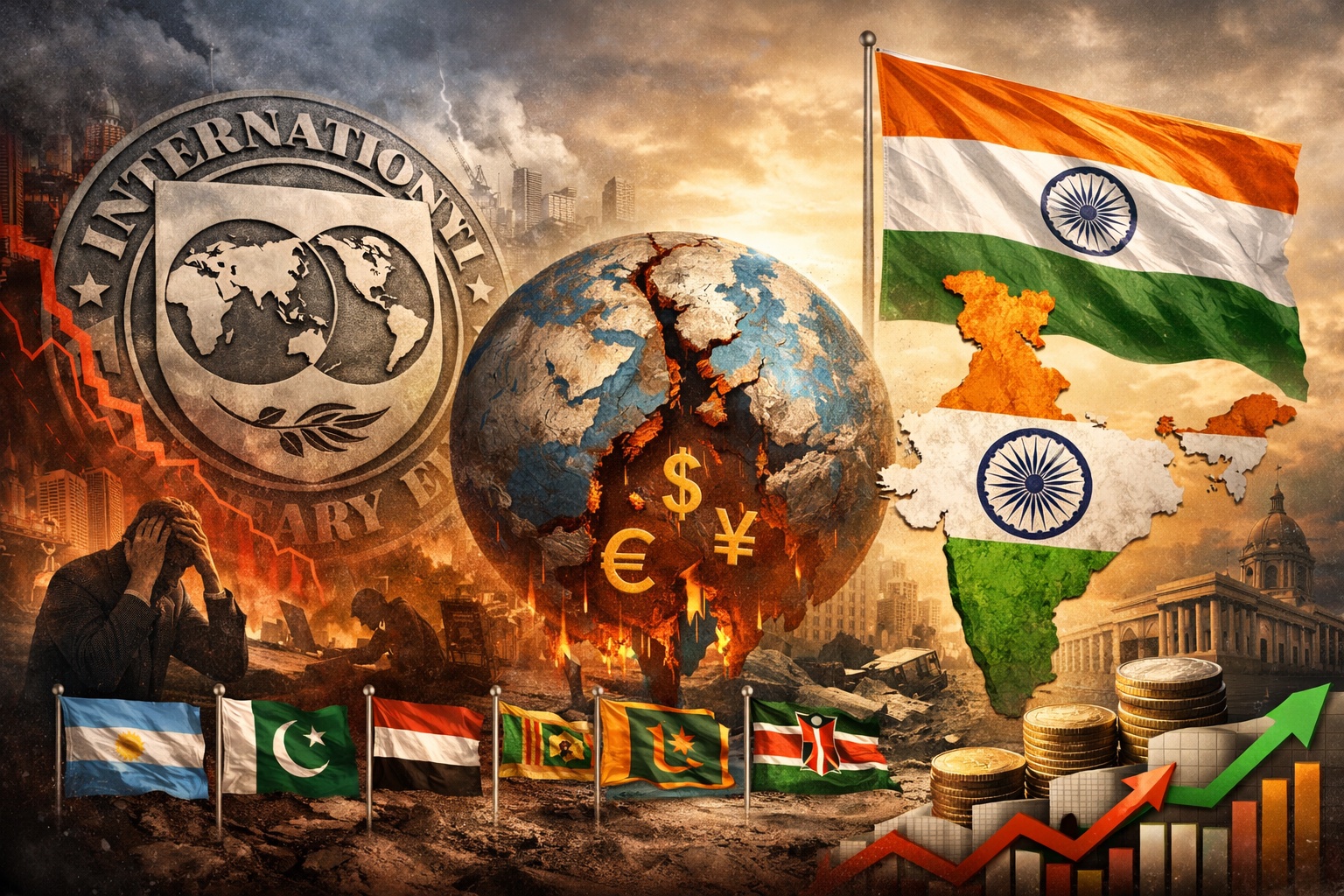
When the International Monetary Fund starts running bailout scenarios, it means the world's most powerful economic institution believes some countries are about to break. Not might break. Are about to.
According to Bloomberg, the IMF's Strategy, Policy and Review department — the unit responsible for designing and evaluating the fund's lending policies — has asked its country desks worldwide to submit analyses on current account status, foreign exchange reserves, and potential funding needs. This is not a routine exercise. It is a quiet acknowledgment that the Iran war has pushed the global economy into territory the IMF hasn't seen since the 2008 financial crisis.
Four weeks after Iran effectively shut the Strait of Hormuz to commercial shipping, the damage is no longer theoretical. It is showing up in emergency declarations, school closures, fuel rationing, and troops deployed to guard petrol stations.
The Emergency Room: Countries Already on Life SupportThe first domino fell on March 24. Philippines President Ferdinand Marcos Jr. declared a national energy emergency — the first country to do so. The Philippines imports 95-98% of its petroleum. Energy Secretary Sharon Garin confirmed the government has roughly 45 to 50 days of supply remaining. Government offices shifted to a four-day work week immediately.
But the Philippines wasn't alone. It was simply the first to say it out loud.
| Country | Emergency Measures Taken | Oil Import Dependence |
|---|---|---|
| Philippines | National energy emergency declared. 4-day govt work week. | 95-98% |
| Pakistan | 4-day work weeks. 50% remote work. Schools closed 2 weeks. Petrol price +Rs 55/litre. | ~85% |
| Bangladesh | Troops at oil depots. Universities closed. Eid light displays cancelled. Fuel caps imposed. | ~95% |
| Sri Lanka | Fuel prices raised 8%. Risk of second economic crisis in 4 years. | ~100% |
| Egypt | Malls, shops, cafes ordered to close early. Fuel prices raised 15-22%. | Net importer |
| Thailand | WFH encouraged. Citizens asked to curtail energy use. | ~70% |
| Vietnam | Travel restrictions. Energy conservation orders. <20 days of oil reserves. | Net importer |
| Myanmar | Alternating driving days imposed. | ~90% |
CNN reported that energy-starved nations in Asia are resorting to "increasingly extreme measures to keep their economies afloat." This is not a metaphor. Bangladesh stationed soldiers at oil depots to prevent hoarding. Pakistan shut down schools to save fuel.
$81 to $106. That's All It Took.Brent crude rose from $81.40 to $106.41 between March 2 and March 20 — a 30.7% increase. Shipping traffic through the Strait of Hormuz fell by 90%. The IEA characterized this as the "greatest global energy and food security challenge in history" — surpassing, by their assessment, even the combined oil shocks of the 1970s.
For countries that import most of their energy, every dollar added to the price of oil is a dollar drained from their foreign exchange reserves, a dollar added to inflation, and a dollar closer to an IMF phone call.
Here's how the vulnerability breaks down, measured by the indicators the IMF is likely using in its stress tests:
| Country | Oil Import Dep. | Forex Reserves | Existing IMF Program? | Risk Level |
|---|---|---|---|---|
| Pakistan | ~85% | ~$10B | Yes ($7B EFF) | Critical |
| Bangladesh | ~95% | ~$20B | Yes ($4.7B) | Critical |
| Sri Lanka | ~100% | ~$5B | Yes ($2.9B) | Critical |
| Egypt | Net importer | ~$35B | Yes ($8B EFF) | High |
| Philippines | 95-98% | ~$100B | No | High |
| Vietnam | Net importer | ~$90B | No | Elevated |
| Thailand | ~70% | ~$220B | No | Elevated |
| India | 87% | $709B | No | Elevated |
The pattern is clear. Countries with existing IMF programs — Pakistan, Bangladesh, Sri Lanka, Egypt — are the most exposed. They were already on financial life support before the war began. The oil shock is an additional injury they cannot absorb.
IMF First Deputy Managing Director Gita Gopinath noted that oil-price shocks hit core inflation in emerging-market economies more than twice as strongly as in advanced ones. For a country like Pakistan, where petrol prices already rose Rs 55 per litre overnight, this means inflation doesn't creep — it sprints.
$709 Billion. But Burning Fast.India will not need an IMF bailout. That much is clear. With $709 billion in foreign exchange reserves — enough to cover over 12 months of imports — India has a buffer that Pakistan, Bangladesh, and Sri Lanka can only dream of.
But here's what the headline number hides.
The Reserve Bank of India sold an estimated $27 billion in March alone to defend the rupee, according to Business Standard. Foreign portfolio investors pulled out Rs 1.03 lakh crore ($11 billion) from Indian markets in March. The rupee fell to a record 93.94 per dollar — its worst single-day drop in over four years.
| India Metric | Before Iran War | Now (Late March) | Direction |
|---|---|---|---|
| GDP Growth Forecast | 7.0% (Goldman) | 5.9% (Goldman) | -1.1 percentage points |
| Rupee/Dollar | ~87 | 93.94 (record low) | -7.4% depreciation |
| Inflation Forecast | 3.9% | 4.6% | +70 basis points |
| Forex Reserves | $728.5B (peak Feb 27) | $709.8B (Mar 13) | -$18.7B in 2 weeks |
| FPI Outflows (March) | — | Rs 1.03L crore ($11B) | Severe |
| Strategic Oil Reserves | 9.5 days cover | 36% unfilled | Far below IEA standard |
| Expected Rate Hike | None | +50 bps (Goldman) | Reversal of easing cycle |
Goldman Sachs cut India's 2026 GDP forecast from 7% to 5.9% and now expects a 50 basis point rate hike instead of rate cuts. That's a complete reversal of the monetary policy trajectory.
India's strategic petroleum reserves cover just 9.5 days of consumption — the lowest of any major economy. Japan's cover 260 days. China's cover over 80. Even the IEA's recommended minimum is 90 days. India's reserves are 36% unfilled.
1973, 1979, 1990. Then 2026.The IEA has placed the 2026 oil shock alongside the four great energy crises of the modern era: the 1973 Arab oil embargo, the 1979 Iranian Revolution, the 1990 Gulf War spike, and now this. But there are critical differences.
In 1973, OPEC weaponized supply against specific countries. In 2026, a chokepoint was physically closed. The Strait of Hormuz carries roughly 20% of global oil and 20% of the world's seaborne LNG. When Iran closed it to commercial traffic on March 3, it didn't target anyone. It hit everyone.
In 1973, the developing world was smaller, less integrated, and less dependent on energy imports. Today, approximately 80% of Asian oil imports pass through the Strait. The Gulf states themselves — once buffered by oil wealth — are now victims too. Kuwait and Qatar face GDP contractions of up to 14%, according to CFR estimates. Iranian strikes damaged desalination plants that supply 99% of drinking water in Kuwait and Qatar.
Why This Could Be Contained
- The U.S. has signaled willingness to lift Iran oil sanctions to ease the crunch
- Seven U.S. allies have pledged to ensure safe Hormuz passage
- Strategic petroleum reserve releases could ease short-term pressure
- Oil prices briefly fell 6% when Trump claimed progress in Iran talks
Why This Could Get Worse
- Hormuz is physically controlled by Iran — diplomatic pledges don't open shipping lanes
- Energy infrastructure in the Gulf has been damaged — rebuilding takes months, not days
- European gas storage was at only 30% entering the conflict
- Fertilizer disruptions (50% of global exports transit the Strait) threaten food supply chains
The IMF is not a charity. When a country receives emergency financing, it comes with conditions — typically austerity measures that include cutting subsidies, raising taxes, reducing public spending, and liberalizing exchange rates. Pakistan has been to the IMF 25 times — a record. Sri Lanka, 17 times. Argentina currently owes the IMF more than the next seven borrowers combined.
The stress test Bloomberg reported is the IMF asking each country desk: If this war lasts another 30 days, another 60 days, another 90 days — does your country run out of money?
Morocco has already warned that if oil prices stay above $120 per barrel, it will need to draw on IMF financing lines. Pakistan's $7 billion IMF program is being renegotiated mid-crisis. The Atlantic Council has argued that the IMF's voice is "urgently needed" but that the institution has been too slow to act.
What Happens on Day 60?The WTO has estimated that if oil and gas prices remain elevated through the rest of 2026, it could reduce global GDP growth by 0.3 percentage points. That sounds small. It represents roughly $300 billion in lost economic output worldwide.
But the real danger isn't the global average. It's the distribution. Europe faces at least 1% lower GDP growth than projected. Germany, the UK, and Italy face technical recession risk. The ECB has already postponed rate cuts. UK inflation is expected to breach 5%.
In the Gulf, the damage is physical, not just financial. 70% of GCC food imports have been disrupted. Consumer prices in some Gulf states have spiked 40-120%. Tourism has collapsed. Airlines have suspended operations, resulting in over 4,000 daily flight cancellations.
And for the developing world — the countries the IMF is now stress-testing — the question is simpler: how many weeks of oil can you afford before you run out of dollars?
Plot Twist: The U.S. Is Reversing Its Own SanctionsIn one of the war's most striking ironies, the United States has begun lifting its own sanctions on Iranian oil to alleviate the energy crisis its war with Iran helped create. CNN reported that Washington is also allowing India to resume Russian oil purchases — just weeks after the February deal where India agreed to stop buying Russian crude in exchange for an 18% tariff rate.
The policy whiplash is extraordinary. In February, the U.S. threatened India with tariffs for buying Russian oil. In March, it's effectively encouraging it. The energy arithmetic has overridden the geopolitical calculus.
The Bottom Line
The IMF doesn't run bailout scenarios as an academic exercise. When Bloomberg reports that every country desk has been asked to assess financing needs, it means the institution sees a real possibility that multiple developing nations will need emergency money in the coming weeks. Pakistan, Bangladesh, Sri Lanka, and Egypt — all already on IMF programs — are most exposed. The Philippines has already declared an emergency. India won't need a bailout, but its $709 billion buffer is being drained at $27 billion a month, its GDP forecast has been cut by more than a full percentage point, and its strategic oil reserves cover less than 10 days. The 2026 oil shock isn't 1973. It's worse — because this time, even the oil-producing economies are burning.