13,000 buses. That's what was promised to Delhi's commuters. The reality? 5,336 buses running. The fleet actually shrank from 7,300 to 5,600 in one year.
1,617 people. That's how many died on Delhi's roads in 2025 — the highest toll in seven years. The budget's allocation for road safety? Zero. Not reduced. Not cut. Zero.
Now there's a new budget: Rs 1,03,700 crore. New government. New promises. Same pattern.
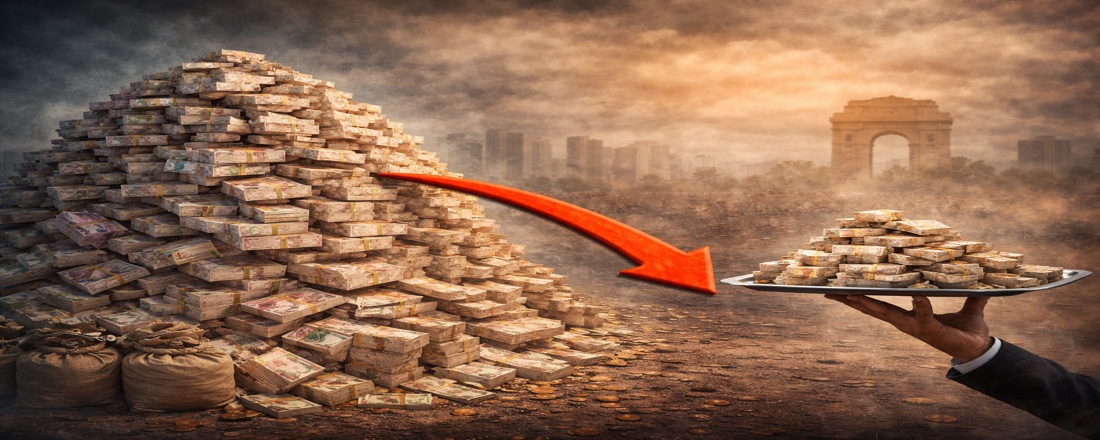
Before the spreadsheets, before the allocations, before the press conferences — this is what daily life looks like for the 2.2 crore people who live in Delhi.
In January 2026, ammonia spikes in the Yamuna shut down six of Delhi's nine water treatment plants. Taps went dry across south and east Delhi. In low-income areas like Sangam Vihar, Madanpur Khadar, and large parts of northeast Delhi, water arrives once every three days — sometimes not at all. Women queue for hours at tankers. Private tanker mafias charge Rs 500-1,500 per trip. This is in a city with a per capita income of Rs 5,31,610 — two and a half times the national average.
Delhi's air remained in the "severe" or "very poor" category for 219 days in 2025, according to CPCB monitoring data. The average AQI in winter months crossed 400 repeatedly. Hospitals reported a 30% spike in respiratory admissions during November-January. Children under five are the worst affected — a Lancet Planetary Health study estimated that Delhi's pollution shaves 11.9 years off the average life expectancy.
On the roads, 2025 was the deadliest year in seven. 1,617 people were killed in road crashes — 649 of them pedestrians and 340 two-wheeler riders. Fatal accidents have increased every single year since 2021. Outer Ring Road, GT Karnal Road, and NH-48 are among the deadliest stretches in the country. Delhi has no dedicated road safety authority. No Vision Zero plan. And now, no dedicated budget line for road safety.
This is not a failure of one party. This is a failure of the system — a pattern that repeats regardless of who presents the budget.
The Scorecard: Promise vs Budget vs RealityDelhi's new government — the BJP's first full budget for Delhi since 1998 — after 27 years out of power — promised a transformation. Here is what was promised in the 2025 election manifesto, what the budget actually allocates, and what the ground reality looks like.
| Sector | Manifesto Promise | Budget 2026-27 | Ground Reality |
|---|---|---|---|
| Yamuna Cleaning | Clean in 3 years, 100% effluent treatment | Rs 9,000 cr (Jal Board) | 22 drains still open. 25% STP capacity unused. Pollution doubled in some stretches. |
| Public Transport | 13,000 electric buses, 24/7 metro | Rs 8,374 cr (transport) + Rs 2,885 cr (metro) | 5,336 buses running vs 11,000 needed. Fleet shrank from 7,300 to 5,600. |
| Women's Welfare | Rs 2,500/month to every woman | Rs 5,110 cr (Mahila Samriddhi) | Pure cash transfer. Zero skill training. Zero enterprise linkage. |
| Health | Ayushman Bharat implementation | Rs 13,034 cr | Mohalla Clinics discontinued. Ayushman rollout in progress. |
| Education | Free laptops, e-scooters for girls | Rs 19,326 cr (18.6%) | Highest sector allocation. Laptops/scooters not in budget. |
| Pollution | End stubble burning impact, clean air | Rs 300 cr (pollution control) | Only 43% utilized last year. MCD left Rs 64 cr unspent for sweepers. |
| Road Safety | Not mentioned in manifesto | Rs 0 (no dedicated line) | 1,617 deaths in 2025. 649 pedestrians killed. Fatalities rising since 2021. |
| Flood Protection | Flood-free Delhi, Rs 700 cr | No dedicated flood line item | Record floods in 2023 and 2024. Yamuna crossed danger mark multiple times. |
| MSMEs | Boost small businesses | Rs 48 cr | Services = 86% of Delhi's economy. Rs 48 cr is 0.046% of the budget. |
Delhi's 2026-27 budget totals Rs 1,03,700 crore — a 3.7% increase over last year. That sounds large. It is not transformative. Adjusted for inflation (approximately 5%), this is a real-terms cut. Here is how the money is distributed across the major heads.
The budget's revenue-to-capital split tells its own story: 70.3% is revenue expenditure — salaries, subsidies, cash transfers, maintenance. Only 29.7% is capital expenditure — new infrastructure, new assets, new capacity. This means for every rupee Delhi spends, 70 paise goes to keeping the existing machinery running. Only 30 paise goes to building something new.
To fund this, the government is borrowing Rs 16,700 crore from the market. This is not inherently bad — most state governments borrow. But when borrowing funds cash transfers rather than infrastructure that generates returns, the debt becomes consumption-driven. The question is not whether Delhi can afford to borrow. It is whether Delhi is borrowing to build — or borrowing to spend.
Rs 8,000 Crore Went Down the Drain. Literally.No issue captures the pattern better than the Yamuna. Every government that has ever ruled Delhi has promised to clean it. Every government has allocated money. The river remains one of the most polluted waterways in the world.
The current budget allocates Rs 9,000 crore to the Delhi Jal Board, which handles both water supply and sewage treatment. This is a substantial sum. But the question was never about money. Delhi has spent more per-capita on river cleaning than most cities in the world. The question is about governance.
Consider the numbers: Delhi has a total sewage treatment capacity of approximately 632 million gallons per day (MGD). The actual sewage generated is around 720 MGD. That leaves a 88 MGD gap — sewage that bypasses treatment entirely. But here is the deeper problem: even of the 632 MGD capacity, roughly 25% sits idle on any given day. Plants break down. Electrical connections fail. Operators are not trained. Sludge management is non-existent at several facilities. The Central Pollution Control Board's 2025 audit found that several Delhi STPs were running at less than 60% of rated capacity — not because they lacked sewage to treat, but because the machinery was not maintained.
No amount of budget allocation fixes a pump that has been broken for three years because nobody filed the maintenance requisition. No manifesto promise repairs an STP that was commissioned without a proper sludge disposal plan. The Yamuna problem is not a money problem. It is a governance problem masquerading as a budget line item.
The Yamuna Verdict
Three parties. Thirty years. Rs 8,000+ crore. Twenty-two drains still open. The issue is not allocation — it is execution. Delhi does not need more money for the Yamuna. It needs functional STPs, trained operators, sludge management infrastructure, and a single accountable authority. None of these require a budget increase. They require governance that no party has delivered.
Delhi needs a minimum of 11,000 buses to provide adequate public transport coverage — a figure determined by the Delhi High Court in a 2018 order that remains binding. The BJP manifesto went further: 13,000 electric buses, 24/7 metro service, a Rs 20,000 crore transport overhaul.
The reality is that Delhi's bus fleet has been shrinking, not growing. In 2023, the combined DTC and cluster bus fleet stood at approximately 7,300 vehicles. By March 2025, that number had dropped to around 5,600 as older buses were decommissioned faster than new ones arrived. As of March 2026, approximately 5,336 buses are operational — barely half of what the High Court mandated eight years ago.
| Metric | Promised / Required | Actual (Mar 2026) | Gap |
|---|---|---|---|
| Total Bus Fleet | 13,000 (manifesto) / 11,000 (HC) | 5,336 | -5,664 to -7,664 |
| Electric Buses | 13,000 (manifesto) | ~800 (deployed) | -12,200 |
| Bus Routes | Coverage for all zones | ~550 routes | North/northeast Delhi severely underserved |
| Avg. Wait Time | 5-10 min (metro standard) | 20-40 min (off-peak) | 2x-4x longer than target |
| Women's Free Bus Ridership | Universal | ~14 lakh trips/day | Budget: Rs 450 cr (funded) |
The budget allocates Rs 8,374 crore for transport and Rs 2,885 crore for metro. These are not small numbers. But the transport allocation covers DTC salaries (one of the highest per-employee costs in Indian public transit), fuel, depot maintenance, and the Rs 450 crore women's free bus scheme. After these recurring costs, the capital available for actually buying new buses is a fraction of the headline figure.
The pattern here is identical to the Yamuna. Every government promises more buses. Every budget allocates money to transport. But the fleet keeps shrinking because the operational economics of DTC are broken — high staff costs, low fare recovery, poor maintenance, and a procurement cycle that takes 2-3 years from tender to deployment. The 13,000 electric bus promise would require approximately Rs 40,000-50,000 crore in procurement alone — four to five times the entire annual transport budget. At the current pace of electric bus deployment (roughly 200-300 per year), it would take over 40 years to reach 13,000.
This is perhaps the most damning number in the entire budget. In 2025, 649 pedestrians were killed on Delhi's roads. Another 340 two-wheeler riders died. Combined, pedestrians and two-wheelers — the most vulnerable road users — account for over 60% of all traffic fatalities.
The budget allocates Rs 1,352 crore for recarpeting 750 km of roads. It allocates Rs 5,921 crore to PWD for general road infrastructure. But there is no dedicated road safety line item. No allocation for crash barriers at black spots. No budget for pedestrian infrastructure redesign. No Vision Zero plan. No speed management programme. No dedicated road safety authority. Nothing.
| Year | Total Road Deaths | Pedestrian Deaths | Dedicated Road Safety Budget |
|---|---|---|---|
| 2021 | 1,239 | 476 | Rs 0 |
| 2022 | 1,307 | 512 | Rs 0 |
| 2023 | 1,411 | 558 | Rs 0 |
| 2024 | 1,508 | 602 | Rs 0 |
| 2025 | 1,617 | 649 | Rs 0 |
| 2026-27 | Budget year | — | Rs 0 |
Five consecutive years of rising fatalities. A clear, measurable crisis. And zero dedicated response in the budget. Why? Because road safety is not politically visible. No party campaigns on it. No CM holds a press conference about it. Nobody organizes a candle-light march for the 649 pedestrians. It is a silent, invisible crisis — and therefore invisible in the budget.
Consider the comparison: Rs 5,110 crore for cash transfers to women. Rs 0 for road safety. Rs 128 crore for Lakhpati Beti Yojana (a savings scheme for girls). Rs 0 for the infrastructure that might keep those girls alive while crossing the road to school. This is not a commentary on the value of women's schemes — it is a commentary on what governments prioritize based on electoral visibility rather than evidence of harm.
What Road Safety Experts Recommend
- World Resources Institute India: Speed management on arterial roads can reduce pedestrian fatalities by 30-40%. Costs: Rs 200-400 crore for citywide implementation.
- SaveLIFE Foundation: A dedicated road safety agency — not traffic police — with authority over design, signage, and enforcement. Model: Bogota reduced fatalities 50% in a decade.
- IIT Delhi Transport Research: Redesign the 50 deadliest intersections. Cost: Rs 150-200 crore. Estimated lives saved: 200-300 per year.
- WHO Global Status Report: Countries with dedicated road safety budgets reduce fatalities 2-3x faster than those that bundle it under "general infrastructure."
Why It Does Not Happen
- No electoral demand: Road safety has no organized constituency. No voter group demands it. No opposition party attacks a government for road deaths.
- Jurisdictional chaos: Roads involve PWD, MCD, NHAI, DDA, traffic police, and transport department. No single authority owns "road safety."
- Construction lobby: Road-widening and flyover projects are lucrative. Pedestrian infrastructure and speed calming are not.
- Data gap: India's crash investigation system does not produce the granular data needed for evidence-based interventions. Most fatalities are recorded as "driver negligence" — not design failure.
The Mahila Samriddhi Yojana — at Rs 5,110 crore — is one of the single largest line items in the budget. It transfers Rs 2,500 per month directly to eligible women. The BJP manifesto made this a flagship promise. The scheme is now operational.
Let us be clear about what this is and what it is not. It is a direct benefit transfer. It puts money in women's accounts. For low-income households, this can be genuinely transformative — covering food, medicine, children's school supplies, or savings. Cash transfers have strong global evidence behind them. The GiveDirectly model, tested across East Africa and South Asia, has repeatedly shown that unconditional cash to poor households improves nutrition, health, and children's school attendance.
But it is also not an economic empowerment programme. It has no skill training component. No enterprise linkage. No conditionality requiring health check-ups, education, or vocational participation. It is, in the language of development economics, a basic income supplement — not an income earned by participating in the economy.
The Case for Mahila Samriddhi
- Direct impact: Rs 2,500/month directly reaches women. No middlemen, no leakage, no bureaucratic filtering. DBT is the most efficient transfer mechanism.
- Freedom of choice: Women decide how to spend. Evidence from MP's Ladli Behna Yojana shows most spend on food, health, and children's education — not "wasteful" items.
- Safety net: For domestic workers, daily wage earners, and women in abusive households, independent income is a literal survival mechanism.
- Scale: Reaches millions instantly. Skill training reaches thousands over years. In a crisis, speed matters.
The Case Against (Without Linkages)
- "Same party that mocked revdi culture": The BJP repeatedly attacked AAP's free water, free electricity, and free bus travel as "revdi" (freebies). Rs 5,110 crore in unconditional cash transfers is the largest "revdi" in Delhi's history — by the same party.
- No conditionality: MP's Ladli Behna and Rajasthan's schemes have added health check-up requirements. Delhi's scheme has none. Missed opportunity for women's health data.
- No graduation pathway: Without skill training, enterprise credit, or vocational linkage, the scheme creates dependency. The woman needs the transfer next month, and the month after, forever.
- Fiscal sustainability: Rs 5,110 crore is nearly 5% of the budget. This must be funded every year, permanently. If Delhi's revenue stalls, this becomes the first pressure point.
The honest assessment is that Mahila Samriddhi is neither purely good nor purely bad. It is good as a safety net. It is inadequate as an empowerment strategy. A government serious about women's economic participation would pair the cash transfer with a skill training programme — the way the NITI Aayog's Women Entrepreneurship Platform recommends. But skill training is slow, complex, and doesn't make for a good headline. Cash transfers do. And so the pattern continues: politically visible over structurally effective.
The Pattern: Why It Repeats — Regardless of PartyThis is the core argument of this analysis. Delhi's budget problems are not the fault of one party. They are the product of a structural pattern that repeats across every government, every election cycle, every budget speech.
Here is the pattern, distilled across three decades and three parties:
| Step | What Happens | Example |
|---|---|---|
| 1. Promise | Party makes visible, emotionally resonant promise during elections | "We will clean the Yamuna in 3/5 years" |
| 2. Allocate | Budget allocates money to the promise. Press conference. Headlines. | "Rs 9,000 crore to Delhi Jal Board" |
| 3. Under-execute | Money sits unspent, or is spent on salaries/maintenance, not outcomes | 25% STP capacity unused. Pollution control: 43% utilization. |
| 4. Ignore the invisible | Problems that are not electorally visible get zero attention | Road safety: Rs 0. MSMEs: Rs 48 crore. |
| 5. Repeat | Next election. New party. Same promises. Same pattern. | Yamuna cleaning: Congress (1993), AAP (2015), BJP (2026) |
The pattern persists because of three structural factors that no single party controls:
1. Delhi's Governance SplitDelhi is not a full state. The elected government controls most departments, but land, police, and public order remain with the Centre through the Lieutenant Governor. This creates a permanent blame game. When road deaths rise, the state blames the Centre (police enforcement is under LG). When buses are late, the Centre blames the state (transport is a state subject). When the Yamuna stays dirty, both blame each other — and both are partially right. This shared jurisdiction means no single authority can be held fully accountable for any outcome. And when nobody is fully accountable, nobody fully delivers.
2. Electoral Incentives Favour Visibility Over OutcomesCash transfers are visible on the day the money hits the account. A clean Yamuna takes 5-10 years of sustained operational work — longer than any election cycle. A new bus takes 2-3 years from tender to deployment. Pedestrian infrastructure redesign does not make the evening news. This creates a systematic bias: governments allocate money to visible, fast, credit-claimable schemes — and under-invest in slow, complex, outcome-dependent work. The result is that Delhi spends Rs 5,110 crore on cash transfers and Rs 48 crore on the small businesses that employ millions.
3. No Accountability for Under-SpendingWhen the pollution control budget utilization is 43%, nobody is fired. When MCD leaves Rs 64.40 crore unspent for mechanical sweepers, there is no public audit. When the DPCC does not use Rs 70 crore earmarked for groundwater remediation, no report is tabled in the Assembly. The budget creates the appearance of commitment without any mechanism to enforce delivery. Allocation without accountability is theatre.
Delhi does not have a revenue problem. With a GSDP of Rs 13,27,055 crore and a per capita income of Rs 5,31,610, it is one of the wealthiest jurisdictions in India. It does not need more money. It needs to spend the money it already has — effectively, accountably, and on the right things.
Here is what evidence-based policy would look like for Delhi's five biggest failures:
1. Yamuna: Fix Governance, Not BudgetsCreate a single, empowered Yamuna River Authority — modeled on the Thames Tideway Tunnel Authority in London or the Ganga Rejuvenation Authority at the Centre. One body. One budget. One accountability chain. Currently, the Yamuna's cleaning involves Delhi Jal Board, DPCC, MCD, DDA, central NMCG, and UP/Haryana governments. When everyone is responsible, no one is responsible. A dedicated authority with a single CEO, clear targets (BOD levels, not "crores spent"), and quarterly public audits would transform outcomes without a single additional rupee.
2. Buses: Fix Procurement, Not PromisesThe bottleneck is not money — it is the 2-3 year procurement cycle. Delhi should switch to a gross-cost contract model (like London) where private operators own and maintain buses while the government sets routes, fares, and schedules. This would allow 3,000-5,000 buses to be added within 18 months without DTC buying a single vehicle. Bogota's TransMilenio and Jakarta's TransJakarta both scaled public transit 5-10x faster using this model than by expanding government-owned fleets.
3. Road Safety: Create a Dedicated AuthorityEstablish a Delhi Road Safety Authority — separate from traffic police, with a mandate covering road design, black spot remediation, speed management, and crash investigation. Budget: Rs 300-500 crore per year (less than what we spend on cash transfers for LPG). Tamil Nadu created a similar body and reduced fatalities 15% in three years. Sweden's Vision Zero programme eliminated urban pedestrian fatalities entirely in several cities. It starts with someone being responsible.
4. Pollution: Enforce What ExistsDelhi does not need a new pollution plan. It needs to execute the existing one. The National Clean Air Programme already exists. The Graded Response Action Plan (GRAP) already exists. The problem is that Rs 300 crore is allocated and only Rs 129 crore is spent. MCD has sweepers budgeted and doesn't deploy them. DPCC has groundwater money and doesn't use it. The fix is a mandatory utilization audit — if a department spends less than 80% of its pollution budget, the shortfall is publicly reported and the department head is called before a legislative committee. Simple. No new scheme required.
5. Women's Empowerment: Pair Cash with EnterpriseKeep Mahila Samriddhi as a safety net. But add a 10% top-up (Rs 511 crore) for women who complete a NSDC-certified skill course, start a registered micro-enterprise, or open a MUDRA loan account. This converts a consumption subsidy into an investment accelerator. Rajasthan's modified Indira Gandhi Urban Employment Scheme added a similar conditionality and saw 30% of beneficiaries transition to self-employment within two years.
The Core Issue
Delhi's budget is not too small. At Rs 1.03 lakh crore, it is larger than the entire GDP of 75+ countries. The problem is structural: 70% goes to revenue (salaries, subsidies, maintenance), only 30% to capital. Allocated money goes unspent. Spent money is not audited for outcomes. Politically invisible crises (road safety, MSMEs, pollution utilization) get nothing. Politically visible schemes (cash transfers, road recarpeting) get everything. This is not a BJP problem or an AAP problem. It is a system that rewards announcements over outcomes, allocation over execution, and visibility over impact. Until that system changes, the next budget — regardless of who presents it — will look exactly like this one.
The Bottom Line
Delhi's Rs 1,03,700 crore budget is not a new story. It is the same story told by a different narrator. The Yamuna has been promised clean for three decades across three parties — it is more polluted today than when the first action plan began. 13,000 buses were promised; 5,336 are running and the fleet is shrinking. 1,617 people died on Delhi's roads in 2025 — more than any year in the last seven — and the budget allocates exactly zero for road safety. Rs 5,110 crore goes to unconditional cash transfers for women — the same party that coined "revdi culture" is now running the largest revdi scheme in Delhi's history. Only Rs 48 crore goes to MSMEs — the businesses that actually employ the women receiving those transfers. The pollution control budget had a 43% utilization rate last year; the new allocation will likely meet the same fate. This is not about AAP vs BJP. This is about a pattern that repeats because the system rewards it: promise big, allocate money, under-spend, ignore the invisible, and move to the next election. Delhi does not need a bigger budget. It needs a system that forces any government — regardless of party — to actually spend what it allocates, measure what it delivers, and account for what it fails. Until that happens, the Yamuna will foam, the buses will not come, and the pedestrians will keep dying. Same budget. Same promises. Same problems.