Mar 3 — Petronet LNG declares force majeure. India's gas lifeline — cut.
Mar 9 — Government invokes Natural Gas Control Order under the Essential Commodities Act.
Mar 14 — Two Indian LPG carriers get "special exception" from Iran to transit Hormuz.
Mar 27 — IRGC turns away 3 container ships from the strait. Fertilizer cargo on board.
Everyone's debating petrol prices.
Nobody's asking: what happens to your food?
For a month now, the national conversation about the Hormuz blockade has centered on one thing: oil. Petrol prices. Diesel costs. LPG cylinder bills. That's understandable — oil is visceral, immediate, something every Indian interacts with daily. But while the country watches the fuel gauge, a far more dangerous chain reaction is unfolding in places most people never think about: fertilizer plants in Gujarat running at half capacity, polybag factories shutting production lines, petrochemical units rationing feedstock.
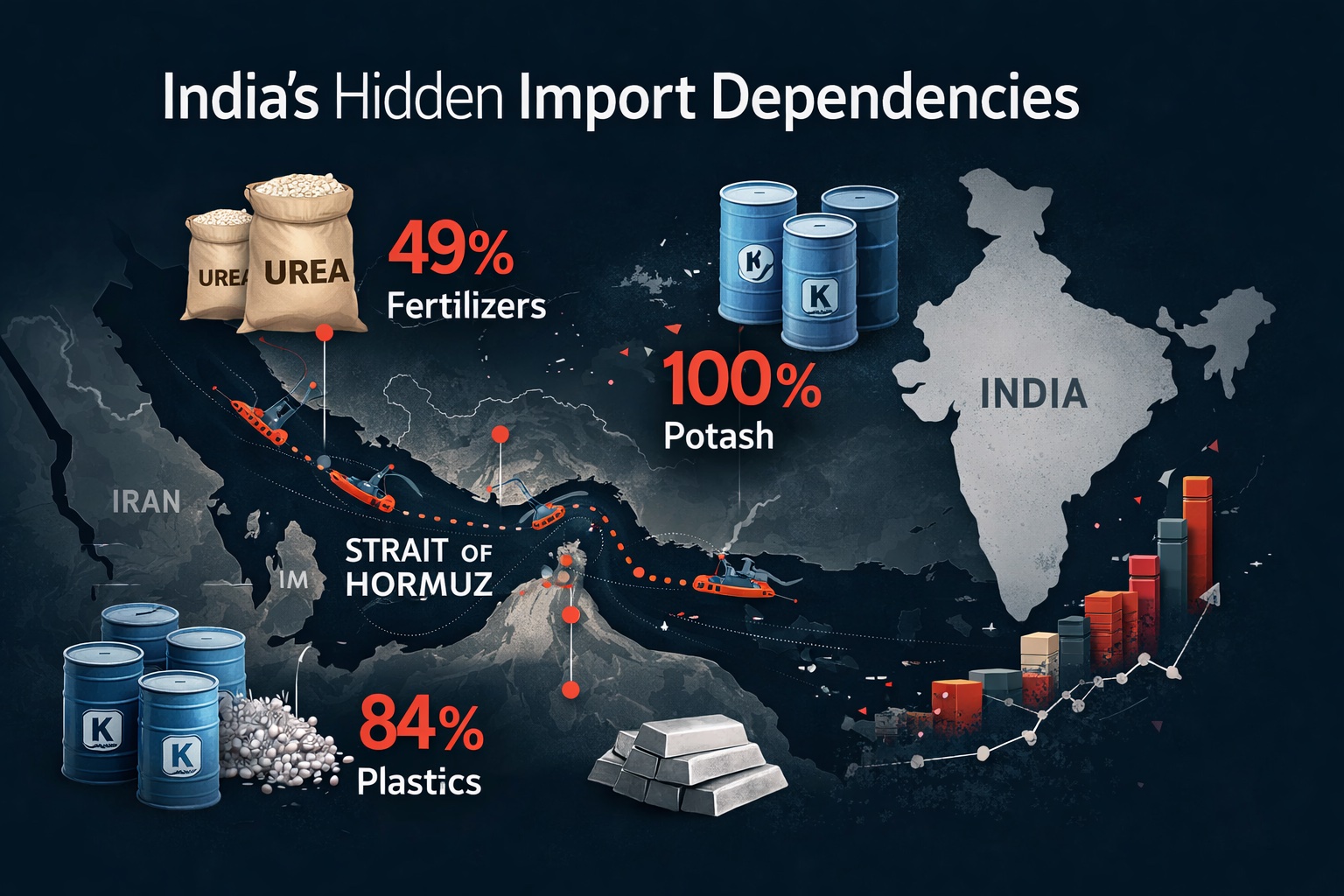
The Strait of Hormuz carries 20% of the world's seaborne oil. That fact gets repeated constantly. Here's the fact that doesn't: it also carries 49% of India's nitrogen fertilizer imports, 100% of India's potash (42% from Saudi Arabia alone), 84% of Middle Eastern polyethylene exports, and the natural gas that fuels 30 of India's 32 urea plants. India's $11 billion fertilizer import exposure to the Persian Gulf is the largest of any country in the world.
The oil crisis has a cushion. India diversified to Russian crude years ago. It has 9.5 days of strategic petroleum reserves. It has options. The fertilizer and petrochemical crisis has none of that. No strategic fertilizer reserve exists. No alternative supplier can replace Gulf volumes at scale. And the clock is ticking toward June, when 140 million farmers need urea for Kharif sowing.
India's Hormuz Shopping ListEvery conversation about the Hormuz crisis starts and ends with crude oil. That's a mistake. Here is the full list of what India sends through that 33-mile strait — the dependencies that nobody is talking about on television.
| Commodity | Import Dependency | % Through Hormuz | Key Supplier |
|---|---|---|---|
| Crude Oil | 85% imported | ~50% | Iraq, Saudi, UAE |
| LPG | 60% imported | 90% | Saudi, Qatar |
| LNG (Natural Gas) | Significant | 53% (Qatar+UAE) | Qatar |
| Urea (Nitrogen Fert.) | 13% imported, gas-dependent | 70% of imports | Oman (46%), Saudi, Qatar |
| DAP (Phosphate Fert.) | 60% imported | ~65% | Saudi Arabia |
| Potash (MOP) | 100% imported | 42% | Saudi Arabia |
| Polyethylene (Plastics) | Significant | 84% of ME exports | Saudi, UAE, Kuwait |
| Aluminum | Significant | Major share | UAE, Bahrain |
Look at that table again. Urea — the nitrogen fertilizer that Indian agriculture literally cannot function without — has a double dependency on the Gulf. India imports 13% of its urea directly, with 70% of those imports coming from Oman, Saudi Arabia, and Qatar via Hormuz. But the deeper vulnerability is domestic production: 30 of India's 32 urea plants require imported natural gas as feedstock, and 60% of India's LNG comes from Qatar. When Hormuz closes, it doesn't just stop ships carrying urea. It stops the factories that make urea.
Potash is even worse. India has zero domestic potash production. Every single kilogram is imported. Forty-two percent comes from Saudi Arabia, transiting Hormuz. Potash is essential for root development in wheat, rice, sugarcane, and pulses. There is no substitute and no domestic alternative.
DAP — diammonium phosphate, the second most-used fertilizer in India after urea — is 60% imported, with roughly 65% of those imports flowing through the strait. Saudi Arabia is the dominant supplier. Polyethylene, the plastic used in everything from food packaging to water pipes to agricultural mulch film, depends heavily on Middle Eastern naphtha and ethylene. Eighty-four percent of Middle Eastern polyethylene exports transit Hormuz. When polyethylene supply tightens, polybag prices go up — and polybags are how India packages, stores, and transports food across the supply chain.
The chain reaction started on March 3, the day Petronet LNG declared force majeure. Petronet is India's largest LNG importer, handling roughly 75% of the country's liquefied natural gas imports at its Dahej terminal in Gujarat. When it declared force majeure, it effectively told the market: we cannot fulfill our contracts. The gas is not coming.
The dominoes fell fast.
Gas allocation cuts: GAIL, India's state-owned gas distributor, immediately cut allocations to industrial consumers. Gujarat Nandi Valley Fertilizers Corporation (GNFC) saw its gas allocation slashed to 60% of normal levels. Other fertilizer plants across Gujarat, Rajasthan, and Uttar Pradesh received similar cuts. The government invoked the Natural Gas Control Order on March 9 — a rarely used provision under the Essential Commodities Act that allows the Centre to redirect gas supplies and ration allocations during a national emergency.
Urea production collapse: With gas supply at 60-65% at many units, India's urea plants began operating at roughly 50% capacity. This is a country that produces 31 million tonnes of urea annually to meet demand of approximately 35 million tonnes. The 4-million-tonne gap is normally filled by imports. Now both production and imports are disrupted simultaneously.
Fertilizer price surge: International urea prices have surged from $300/tonne to $420/tonne — a 40% jump. DAP has hit $800/tonne, up 38% from $580 pre-crisis. These prices are not academic figures. They translate directly into what state governments and the Centre pay for fertilizer subsidies, and ultimately what farmers pay at the retail counter. The Fertiliser Association of India (FAI) has formally warned that shortages are "expected if the war continues past Q2 2026."
Polybag crisis: Here's the one nobody predicted. Polybags — the plastic bags used to package everything from rice and wheat to cement and chemicals — depend on polyethylene and polypropylene, both derived from naphtha. With naphtha costs surging due to crude oil price increases, polybag prices have jumped 80%. This doesn't just affect plastic manufacturers. It affects the entire food distribution chain. Grain procurement, packaging, cold chain logistics — all of it uses polybags. An 80% increase in packaging costs feeds directly into food inflation.
The chain, in full: Gas supply cut → Urea production halved → Fertilizer prices surge → Kharif crop at risk → Food prices rise → CPI inflation climbs → Monetary policy constrained → GDP forecast cut. Every link in this chain is already activated. The question is how far it runs.
The Numbers. All of Them.Here is the full economic damage assessment as of March 28, 2026 — four weeks into the Hormuz blockade. These are not projections. These are current market prices and revised forecasts from Goldman Sachs, the IMF, and the OECD.
| Impact | Before Crisis | Now | Change |
|---|---|---|---|
| Brent Crude | $72/barrel | $105+ | +46% |
| Urea Price | $300/ton | $420/ton | +40% |
| DAP Price | $580/ton | $800/ton | +38% |
| Polybag Prices | Baseline | +80% | +80% |
| Rupee vs USD | Rs 86 | Rs 89.4 | -4% |
| India GDP Forecast | 7.0% | 5.9% | -1.1pp |
| Inflation Forecast | 3.9% | 4.6% | +0.7pp |
| Current Account Deficit | 1.3% GDP | 2.0% GDP | +0.7pp |
The Goldman Sachs GDP downgrade from 7.0% to 5.9% is the most aggressive revision by any major bank. But it reflects a simple arithmetic: India's net oil import bill rises approximately $12-15 billion for every $10/barrel increase in crude. From $72 to $105 is a $33 increase — that's roughly $40-50 billion in additional import costs annually. That money drains from the current account, weakens the rupee, raises input costs for manufacturers, and ultimately shows up in consumer prices.
The rupee's slide from Rs 86 to Rs 89.4 per dollar compounds the damage. Every barrel of oil India buys is priced in dollars. A weaker rupee means India pays more in rupee terms even if the dollar price holds steady. It's a vicious cycle: oil imports weaken the rupee, and a weaker rupee makes oil more expensive.
India Called China. That Tells You Everything.Of all the signals emerging from this crisis, one stands out for what it reveals about the depth of India's predicament. Outlook Business reported in mid-March that India has quietly approached China for emergency urea imports. Not publicly. Not through official diplomatic channels. Through back-channel trade negotiations.
Think about what that means. For six years, India has been systematically reducing its economic dependence on China. The FDI restrictions imposed after the 2020 Galwan clash. The PLI schemes designed to bring manufacturing home. The "Atmanirbhar Bharat" framework built explicitly to reduce Chinese leverage over India's supply chains. The ban on Chinese apps, investment screening, and border restrictions — all of it pointed in one direction: strategic decoupling from Beijing.
And now, four weeks into a fertilizer crisis, India is calling Beijing for help.
The diversification push extends beyond China. India is in active negotiations with Russia for urea shipments via the Northern Sea Route, with Belarus (the world's largest potash exporter, though under Western sanctions), with Morocco (for phosphate rock), and with Indonesia (for LNG). The government is reportedly in talks with 40 countries for energy diversification.
But here's the core problem: oil has alternatives. India successfully pivoted to Russian crude after the 2022 Ukraine war, and roughly 60% of India's crude oil already comes from non-Hormuz routes. That diversification was years in the making. Fertilizer diversification hasn't happened. The supplier base for urea, DAP, and potash is narrow. The Gulf dominates because it has the gas, the phosphate rock, and the export infrastructure. Finding replacement volumes at scale — in the middle of a crisis, with global prices surging — is orders of magnitude harder than finding replacement oil.
The China approach is a symptom, not a solution. China is itself the world's largest fertilizer consumer and tightly controls exports. It banned urea and phosphate exports in 2021-22 to protect domestic supply. Any volumes India secures from China will be small, expensive, and politically costly. But the fact that India is asking tells you everything about how limited the options are.
Can the Damage Be Undone?The government and industry are telling two very different stories about where India stands. Both are partially right. Here are both views, laid out side by side.
Government's Position
- Urea stocks at record 61.14 lakh MT (up from 55.22 LMT last year)
- DAP stocks doubled to 24.24 lakh MT
- Gas supply to urea plants up 23% (32 to 39.31 MMSCMD)
- Fast-tracked 13.5 lakh MT urea imports from diverse sources
- "No shortage reported during Kharif 2025 or Rabi 2025-26"
- Imports diversified to Russia, Belarus, Morocco, China, Indonesia
- Essential Commodities Act invoked to prioritize fertilizer gas supply
Critics / Industry Warning
- FAI warns shortages expected if war continues past Q2
- Plants still at ~50% capacity — buffer stocks are being consumed, not replenished
- Strategic oil reserves = only 9.5 days (some estimates: 6 days actual usable)
- SPR Phase II (Chandikhol/Padur expansion) delayed until 2030
- Gas supply was cut to 65% at some units — you can't produce what you can't fuel
- India has no strategic fertilizer reserve (unlike oil SPR)
- Buffer stocks cover 4-6 weeks — not 4-6 months
The government's numbers are real. Buffer stocks are at record levels — 61.14 lakh MT of urea and 24.24 lakh MT of DAP were built up ahead of the Kharif season. Gas supply allocations to fertilizer plants were increased by 23% as part of emergency prioritization. These are genuinely positive measures, and they buy India time.
But the critics' math is also real. At 50% capacity, India's urea plants are burning through buffer stocks faster than they can replenish them. The record stockpile is a one-time buffer, not a sustainable production rate. If imports remain disrupted and domestic production stays at half-capacity, those 61 lakh MT of urea stocks last approximately 4-6 weeks of normal consumption. After that, India faces physical shortages — not higher prices, actual unavailability of fertilizer at the district level.
The critical distinction: India has a Strategic Petroleum Reserve for oil. It has no equivalent for fertilizer. There is no underground cavern full of urea or DAP waiting to be released in an emergency. The buffer stock is simply normal inventory that happens to be at seasonal highs. It was built for routine demand fluctuations, not for a Gulf-wide supply disruption lasting months.
One Strait. Zero Alternatives. For Now.The immediate question every policymaker is asking: can anything bypass Hormuz?
The short answer is: not at meaningful scale. The Saudi East-West Pipeline (Petroline) can carry about 1.65 million barrels per day from the Gulf to the Red Sea port of Yanbu. The UAE Fujairah Pipeline (ADCOP) carries another 1.5 million bpd to Fujairah on the Gulf of Oman coast, bypassing Hormuz. Combined, that's about 2.6 million bpd of bypass capacity.
The problem: approximately 20 million bpd of oil flows through Hormuz on a normal day. The bypass pipelines handle 13% of that. And both pipelines are within range of Iranian ballistic missiles — the same missiles that hit US bases in Qatar and Bahrain on March 1. Bypass infrastructure that can be destroyed by the same adversary you're trying to bypass isn't really a solution.
The Cape of Good Hope route — sailing around Africa — adds approximately 14 additional days to a tanker's journey from the Gulf to India and massively increases fuel costs per voyage. Some tankers have already rerouted, but the capacity is limited by the global fleet's availability and the congestion at Suez and South African ports.
The longer-term plays are the International North-South Transport Corridor (INSTC) — a rail-ship-road network connecting India to Russia through Iran and Central Asia — and the Chabahar port in southeastern Iran, which India has been developing to bypass Pakistan for Afghan trade. Both are real infrastructure with real potential. Neither is ready to handle emergency commodity flows at the volumes India needs.
Goldman Sachs expects Hormuz to normalize by mid-April. That projection assumes the US-Iran military escalation doesn't worsen and that diplomatic back-channels produce some form of de-escalation. It's optimistic, and Goldman itself acknowledges the uncertainty. The Washington Post's editorial board called for new bypass pipelines — but pipelines take 5-10 years to build. They're a solution for the next crisis, not this one.
What If This Drags to June?This is the question that determines whether India faces a manageable disruption or a genuine food security crisis. The answer depends entirely on timing.
The global context makes India's position worse, not better. The OECD estimates the war has added 1.2 percentage points to global inflation. European natural gas storage has fallen to 30%, with TTF prices doubling to over EUR 60/MWh. Goldman puts US recession probability at 30%. China's GDP growth is expected to fall below 3%. Global stock markets are down 5.5%, with Asian markets the worst hit.
If a global recession materializes, India faces a double squeeze: import costs spike (oil, gas, fertilizer) while export earnings collapse (IT services, textiles, gems — all demand-dependent on Western consumers). The current account deficit, already projected at 2.0% of GDP, could widen further. The rupee, already at Rs 89.4, would face additional depreciation pressure from both capital flight and trade imbalance.
The worst-case scenario is not hypothetical. It's a combination of factors, each of which is already partially in play: prolonged Hormuz blockade + poor monsoon + global recession + fertilizer shortages at Kharif sowing. If all four converge, India faces the most serious food security challenge since the 2008 global food crisis — but with a much larger population and much higher expectations.
The Wake-Up CallThe Strait of Hormuz has been a known chokepoint since the 1980s Iran-Iraq "Tanker War." It nearly closed during the 2019 Iran-US tensions when Iran seized a British tanker. Every strategic planning document produced by India's Integrated Defence Staff, the Ministry of Petroleum, and the Niti Aayog for the past two decades has identified Hormuz dependency as a critical vulnerability. This is not a surprise. It's a forecast that came true.
To India's credit, oil diversification happened. After the 2022 Ukraine war, India moved aggressively to secure discounted Russian crude. Today, roughly 60% of India's crude oil already comes from non-Hormuz routes — Russia via the Baltic and Black Sea, West Africa, the Americas. The oil hedge works. India is far better positioned on crude than it was in 2019.
But fertilizer and petrochemical diversification did not happen. The supplier base for urea, DAP, and potash remained concentrated in the Gulf. Domestic urea production remained dependent on imported LNG from Qatar. No strategic fertilizer reserve was built. Polyethylene and polypropylene import sources weren't diversified. The lesson of oil wasn't applied to the commodities that sit one level deeper in the supply chain — the ones that don't make headlines until it's too late.
The structural lesson is simple and uncomfortable: single-chokepoint dependency for any critical commodity is a national security risk. It doesn't matter whether that commodity is oil (which India partially fixed), natural gas (which it didn't), or fertilizer (which it completely ignored). The vulnerability is structural, not commodity-specific. And the solution — diversified suppliers, strategic reserves, domestic production capacity, bypass infrastructure — takes years to build. It cannot be improvised during a crisis.
The Pattern
India diversified oil after every Gulf crisis — and it worked. But it never diversified the commodities one layer deeper: the natural gas that fuels fertilizer plants, the potash that India can't produce domestically, the petrochemicals that make the packaging for food. The crisis isn't in your petrol tank. It's in the supply chain between the Gulf and your plate. And that supply chain has exactly one route.
The Bottom Line
India can weather a 4-6 week Hormuz disruption. Buffer stocks are at record levels. The government has moved fast on emergency imports and gas reallocation. But if this war drags past June — when 140 million farmers need urea for Kharif, when a poor monsoon looms with 60% probability, when global recession bites and export earnings fall — the damage won't be in petrol prices. It'll be in food prices, factory costs, and a GDP forecast that keeps getting cut. Goldman has already slashed growth from 7% to 5.9%. The rupee has already lost 4%. Polybag prices are already up 80%. Urea plants are already at half capacity. The crisis has exposed something uncomfortable: India diversified its oil, but left its food chain running through a single 33-mile strait. 49% of nitrogen fertilizer imports. 100% of potash. 84% of polyethylene. 30 of 32 urea plants dependent on Gulf gas. No strategic fertilizer reserve. No bypass. No Plan B. The real Hormuz crisis isn't at the petrol pump. It's at the kitchen table.