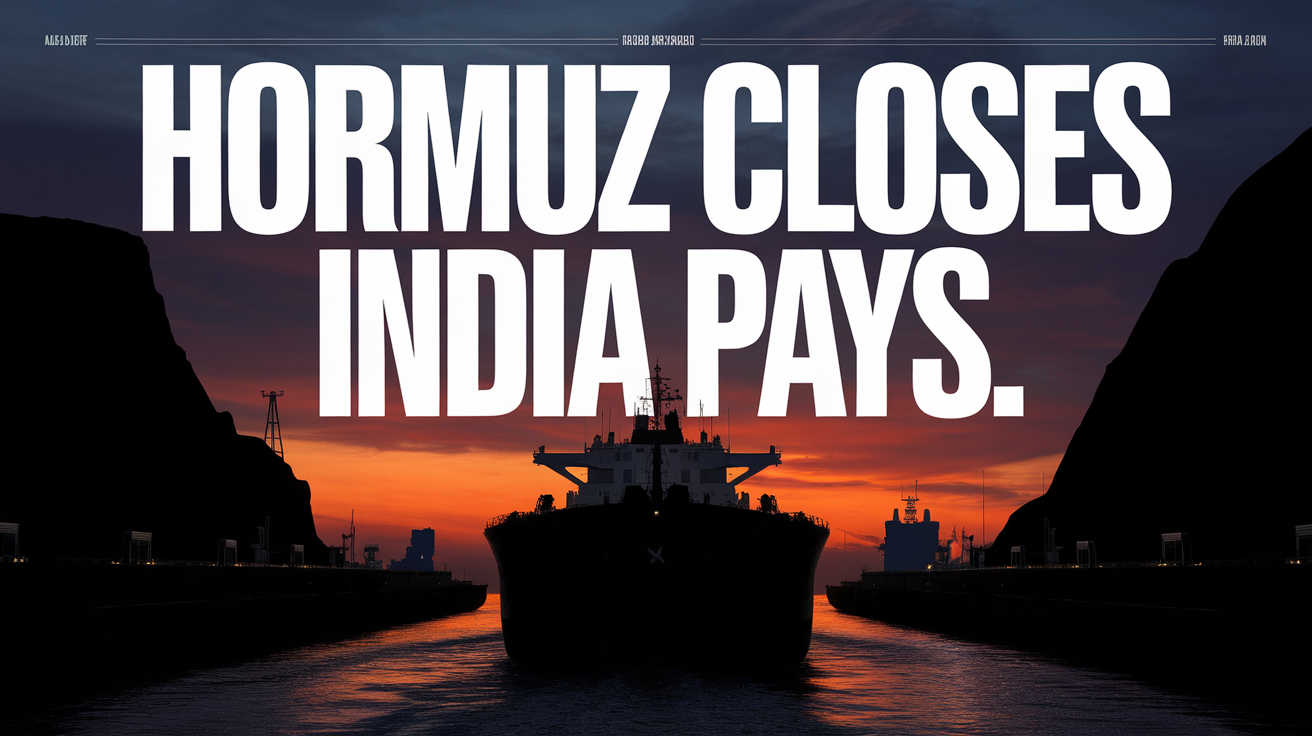
Hormuz Closes Again. India Pays First, Admits Last.
The Chokepoint Just Got Tighter
Iran's Islamic Revolutionary Guard Corps has imposed strict navigation rules on the Strait of Hormuz and declared it closed in response to a US blockade on Iranian ports. This is not a drill or a threat — it is an operational reality. The 50-day-old conflict has already wiped out $50 billion in oil output globally. Over 20% of the world's seaborne crude transits Hormuz daily. India sits directly downstream of every barrel that doesn't make it through.
Every Jamnagar Refinery Manager Already Knows
India imports roughly 85% of its crude oil, and a significant share moves through or originates from Hormuz-adjacent producers — Iraq, Saudi Arabia, UAE. Any sustained closure or IRGC-enforced delay adds freight cost, insurance premiums, and route-rerouting expenses that land squarely on Indian refiners within 30 to 45 days. That passes to petrol pump prices within 60. The rupee weakens as the import bill swells. Retail inflation, already sticky, gets a fresh push. Indian households absorb the shock before any government press conference acknowledges it. Five to ten years out, if Hormuz becomes a recurring leverage point for Tehran, India's entire energy security architecture — built on Gulf dependency — needs structural surgery it has not yet scheduled.
Japan, 1973. India Should Not Forget It.
When OPEC members embargoed oil in 1973, Japan — then almost entirely dependent on imported crude by most historical accounts — took the hardest punch of any Asian economy. GDP contracted, inflation spiked sharply by some estimates into the high double digits, and Tokyo spent the next decade rewiring its energy mix toward nuclear and LNG diversity. India in 2026 mirrors Japan in 1973 more closely than any comfortable official will admit: deep import dependence, thin strategic petroleum reserves, and a government communication culture that prioritises calm over candour. Japan learned. India keeps postponing the lesson.
Petroleum Ministry Must Act in the Next 30 Days
The Petroleum Ministry should immediately direct Indian Oil Corporation and HPCL to pre-buy 15 to 20 days of additional crude inventory from non-Gulf suppliers — US WTI, Russian Urals via existing channels, and West African grades — before spot prices fully price in the Hormuz premium. This is a named, executable action, not a committee recommendation. The contrarian point mainstream coverage missed: traders have already placed over $1 billion in suspiciously well-timed bets on this conflict, per The Guardian. Somebody knew. India's state refiners, as usual, are reacting rather than positioning. Watch the Brent-Dubai spread in the next 30 days — if it widens meaningfully beyond recent norms, the pump price hike thesis gains real weight and becomes difficult for any ministry to defer.
Sources
- Economic Times — IRGC imposing strict navigation rules in the Strait of Hormuz amid US blockade on Iranian ports
- Economic Times — Strait of Hormuz declared closed by Iran military command in response to US blockade
- NDTV Profit — 50-day conflict wiping out $50 billion in oil output globally
- The Guardian — Traders placing over $1 billion in well-timed bets on the Iran conflict